Introduction
A person walks out of the hospital with healed bones and a clear scan, then can't follow a recipe, keep an appointment, or hold a conversation without losing the thread.
Cognitive changes after TBI are often invisible to others, which makes them easy to dismiss and hard to live with.
Common struggles include memory lapses, trouble focusing, slowed thinking, poor planning, and mental exhaustion. These problems follow concussion, stroke, anoxic injury, and other acquired brain injuries.
Cognitive rehabilitation therapy offers an individualized response. It builds specific skills, teaches workarounds, and helps people take part in daily life again.
This article covers assessment, techniques, occupational therapy, team-based care, caregiver support, and realistic goals. Treatment and outcomes vary by injury type, severity, health, and personal needs.
Key Takeaways
- Cognitive rehabilitation targets thinking and communication; CBT targets thoughts, mood, and behavior.
- Good assessment links test results to real-life tasks like managing appointments or cooking.
- Strong programs pair skill practice with tools such as calendars, alarms, and routines.
- Progress is measured against individual functional goals, with a coordinated team and family education.
What Cognitive Therapy for TBI Is and What It Treats
Cognitive rehabilitation therapy: purpose and scope
Cognitive therapy for TBI usually means cognitive rehabilitation: a structured, goal-oriented part of brain injury rehabilitation. Health.mil describes it as a set of strategies for memory, attention, perception, learning, planning, and judgment problems caused by brain injury.
Treatment can improve underlying skills, teach strategies that compensate for lasting difficulties, or combine both so the person functions more safely and independently.
How it differs from related therapies
- Cognitive behavioral therapy (CBT): supports mood, anxiety, sleep, and unhelpful behavior patterns. It does not replace therapy for memory, attention, or executive-function problems.
- Occupational therapy (OT): applies cognition to real daily activities and adapts tasks and environments.
- Speech-language pathology (SLP): addresses cognitive-communication, language, and swallowing.
The overlap is real. A good team coordinates around function and participation rather than guarding its own turf.
Cognitive domains commonly addressed
- Memory and learning: remembering instructions or new routines
- Attention and processing speed: staying focused during a conversation
- Executive function: organizing a day, judging safety risks
- Problem-solving: handling competing demands without becoming overwhelmed
- Language: finding the right word
- Social cognition and awareness: reading cues and recognizing limitations
How Brain Injury Is Assessed and Treatment Goals Are Set
How brain injury is assessed
Assessment starts with the person’s story. Clinicians gather details on:
- Injury history and medical records
- Medications, sleep, pain, and fatigue
- Mood, vision, and hearing
- How the person manages daily responsibilities
Clinicians then add standardized cognitive or neuropsychological testing, functional observation, caregiver interviews, and discipline-specific evaluations. No single test or scan settles the plan. The VA/DoD guideline for post-acute mTBI calls it a clinical diagnosis with no definitive objective test, and advises against using imaging to direct care.
Clinicians also compare test findings with real-world performance. Fatigue, depression, anxiety, pain, hearing or vision loss, and medication side effects can all depress results, so clinicians address those factors first.
What is involved in an OT assessment?
An OT assessment looks at the whole person in context:
- Occupational profile: routines, priorities, and history from the client's view
- Self-care, home responsibilities, work or school demands
- Community participation and safety awareness
- Observed tasks such as a multistep routine, cooking, managing medication reminders, handling money, or using transportation
The therapist evaluates both the person and the task or environment, since a small change to either can make the difference.
Turning findings into individualized goals
Goals should be measurable and matter to the person. Common targets include:
- Finishing a morning routine
- Sustaining a conversation
- Handling work duties
- Managing medications
The team sets a baseline, tracks functional progress, involves caregivers when appropriate, and adjusts difficulty as abilities, fatigue, and circumstances shift.
Success Rehabilitation, for example, builds an Individual Program Description from outcome measures tied to major life activities, and uses the Mayo-Portland Adaptability Inventory (MPAI-4) to measure functional outcomes.
Cognitive Rehabilitation Techniques Used in TBI Recovery
Restorative and compensatory approaches
Restorative practice repeatedly trains a targeted skill under graded conditions. Compensatory methods use tools, routines, environmental changes, or help when a deficit remains.
Compensation is not failure. It improves safety and independence now, while restorative work continues or when full recovery of a skill is uncertain. The ACRM review by Cicerone and colleagues supports both, tied to everyday function.
Attention and information processing
Graded practice builds attention in stages:
- Focusing on one stimulus
- Filtering distractions
- Sustaining attention and switching tasks
- Handling two demands at once
The strongest versions use real situations: listening to instructions, completing paperwork, shopping, or sitting in a meeting.
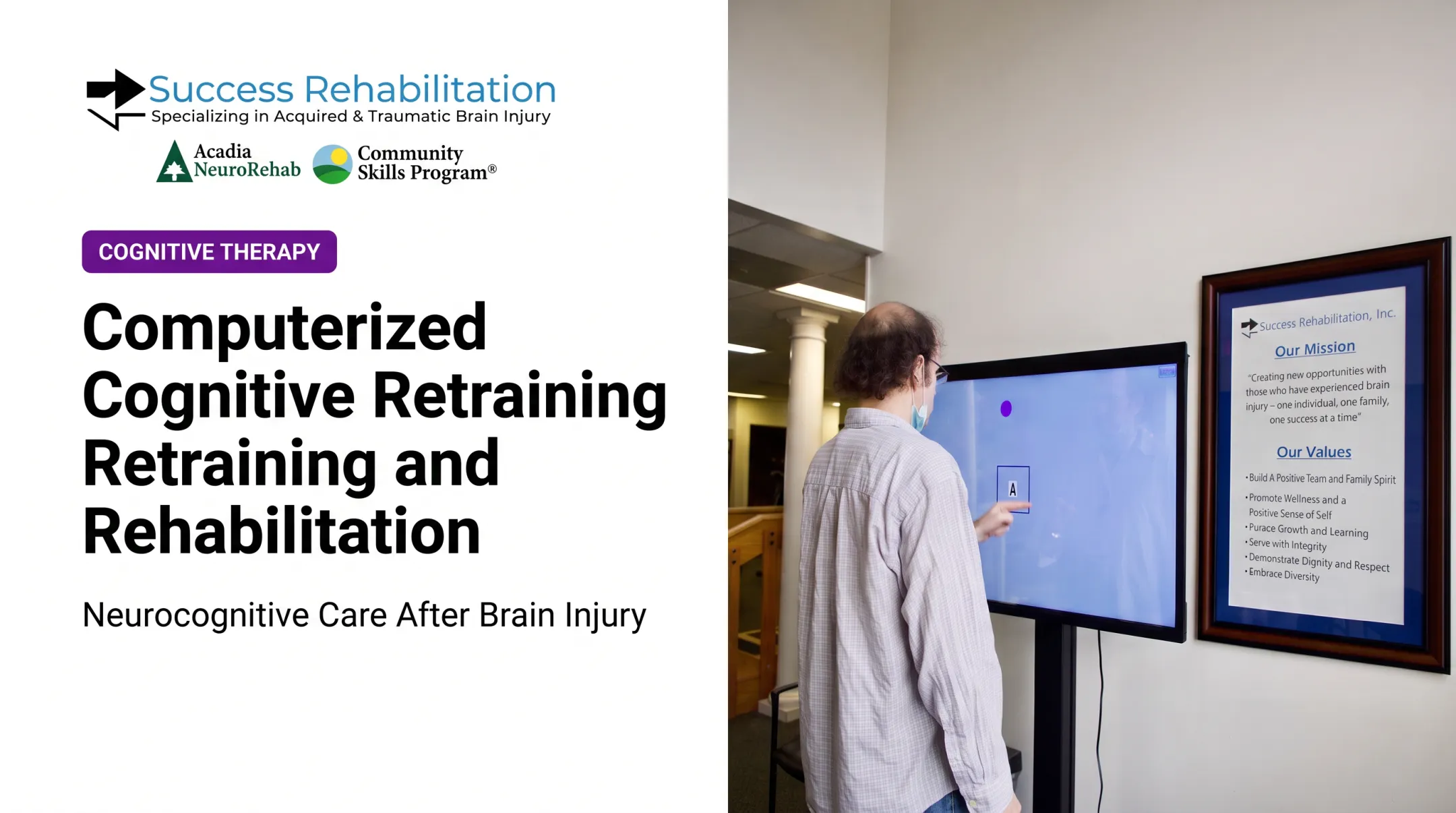
Guidelines favor strategy training in everyday activities over decontextualized computer drills, which show poor transfer. Therapists also account for cognitive fatigue.
Memory and learning
- Encoding aids: repetition, spaced practice, categorization, visualization, mnemonics
- External aids: notebooks, calendars, alarms, phone reminders
- Delayed-recall practice with written checklists
For example, a therapist might teach a new medication routine with a checklist, then test recall after a delay and fade the cues. When deficits or safety concerns are significant, a qualified clinician should select and grade the exercises.
Executive function, reasoning, and problem-solving
Therapy targets:
- Planning and sequencing
- Initiation and flexible thinking
- Self-monitoring and judgment
A therapist may break a complex job into steps, teach a plan-do-check routine, practice spotting errors, then gradually reduce cues as independence grows.

Cognitive-communication and social cognition
Work includes word retrieval, following and expressing ideas, reading conversational cues, taking turns, interpreting tone, and repairing breakdowns. Practice belongs in meaningful settings: family conversations, medical appointments, work, and community groups, not isolated drills alone.
Generalization, fatigue, and carryover
Skills must leave the treatment room. Carryover usually includes:
- Home practice and community tasks
- Caregiver coaching
- Environmental changes and steady routines
Pacing matters too. MSKTC advises stopping an activity before getting tired and taking regular rest breaks.
Add reduced distractions, good sleep habits, and slow increases in demand. Brain-training games and unsupervised exercises do not work for everyone, so check with the treating clinician first.
How Cognitive Therapy Fits Into Multidisciplinary Rehabilitation
Roles within the rehabilitation team
Depending on the person's needs, cognitive therapy coordinates with:
- Occupational therapy (OT): daily activities, thinking skills, vision, and equipment
- Speech-language pathology (SLP): communication, language, and swallowing
- Physical therapy (PT): movement, balance, endurance, and safety
- Neuropsychology and behavioral health: memory, mood, behavior, and family counseling
- Nursing, medical care, social work, and vocational services: health monitoring, care coordination, and return-to-work support
Coordination matters because memory and attention strategies should carry into mobility, self-care, medications, return-to-work planning, and community life.

Choosing the appropriate rehabilitation setting
- Residential: higher supervision and medical or behavioral needs
- Outpatient: people living at home who can travel to therapy
- Home-based: practice in the real environment, useful when transportation or endurance is limited
- Community-based: work, shopping, and transit skills where they are used
The right setting changes over time. Current function, safety, goals, available support, and the treating team's advice should drive the choice.
Success Rehabilitation's continuum
Success Rehabilitation provides post-acute brain injury services across residential, outpatient, neurocognitive, home-based, and community-based settings. Residential programs are in Pennsylvania; New Jersey offers home- and community-based services. Individuals, families, caregivers, and referring professionals can contact the team to learn which setting may fit.

Choosing Support and Carrying Progress Into Daily Life
Questions to ask when evaluating a program
The Brain Injury Association of America suggests asking about staff, licensing, outcome data, and references. Useful follow-ups include:
- How experienced are clinicians with TBI and acquired brain injury?
- Which assessment methods are used?
- How are goals individualized and progress tracked?
- How do disciplines communicate?
- How are caregivers involved?
- How does the program handle fatigue, safety planning, and transitions?
Also ask how it treats mild or "invisible" symptoms as well as severe impairment, and how therapy connects to home, work, school, and transportation.
Supporting carryover at home
Skills stick when home routines match what therapy already practices:
- Use clinician-approved routines and written instructions
- Keep calendars, alarms, and a quiet workspace
- Give one-step or short-step cues
- Keep important items in the same place
- Plan rest periods
Support the person without taking over every task. Share observations with the team, reinforce agreed strategies consistently, and avoid raising difficulty too quickly. Generic online exercises are no substitute for individualized care.
When to seek reassessment
Contact the treating clinician when:
- Progress stalls
- Fatigue becomes unmanageable
- New safety risks appear
- Strategies stop working
- Demands change through work, school, driving, or independent living
Safety note: The CDC lists danger signs such as worsening headache, repeated vomiting, seizure, slurred speech, confusion, or inability to wake. Seek urgent medical care for sudden or worsening neurological symptoms. Bring rehabilitation questions to the healthcare team.
Frequently Asked Questions
What is cognitive rehabilitation for TBI?
It is individualized therapy for memory, attention, executive function, problem-solving, language, and cognitive-communication skills. It combines restorative exercises with compensatory strategies.
How is brain injury assessed?
Clinicians review medical history and symptoms, then add cognitive or neuropsychological testing, functional observation, caregiver input, and discipline-specific evaluations. No single test determines the full plan.
What is involved in an OT assessment?
OT evaluates daily activities, routines, safety, home or work demands, task performance, and environmental barriers. The result is a set of practical strategies and adaptations.
What are effective occupational therapy interventions for brain injury?
Common options include task sequencing, routine development, environmental modifications, memory aids, fatigue management, safety training, graded activity practice, and caregiver education.
What can be done for anoxic brain injury?
Care depends on the cause, severity, affected functions, medical status, and time since injury. It may include coordinated cognitive, occupational, speech-language, physical, behavioral, and community-based rehabilitation.
How does brain injury affect memory?
Injury can disrupt attention, encoding, storage, retrieval, or prospective memory (remembering future plans). Treatment combines targeted practice with reminders, routines, and written information.