It also isn't just about "talking normally" again. Recovery can involve pronunciation, word finding, understanding language, memory, attention, conversation skills, or swallowing.
This article covers common communication effects, realistic expectations, speech-language pathology, family support, and how to choose ongoing rehabilitation. It is educational and not a substitute for medical care.
Key Takeaways
- Many people improve after brain injury, but outcomes and timelines vary.
- Aphasia, dysarthria, apraxia, and cognitive-communication problems need different treatment.
- Speech-language pathology also covers cognition, swallowing, and communication tools.
- Family support helps therapy gains carry into daily life.
How Brain Injury Can Affect Speech and Communication
The location, severity, and type of injury shape which skills are affected: language, thinking, or the muscles used for speech. Fatigue, headaches, attention problems, and emotional changes can make communication harder still.
Common speech and language disorders
- Aphasia is a language impairment that can affect speaking, understanding, reading, and writing, according to NIDCD. A person may know what they want to say but struggle to retrieve or organize the words.
- Dysarthria involves weakness or poor control of the speech muscles, so speech sounds slurred or strained.
- Apraxia of speech affects the planning and sequencing of speech movements, not muscle strength.
- Cognitive-communication problems involve attention, memory, reasoning, and organization.
- Social communication difficulties include rambling, going off topic, trouble taking turns, and missing nonverbal cues.
Swallowing problems often accompany these disorders. A speech-language pathologist (SLP) can evaluate them, but swallowing needs individualized safety guidance, not unsupervised exercises.
When to seek prompt medical attention
Sudden new or worsening speech difficulty, confusion, weakness, or a severe headache needs urgent evaluation. Don't assume it's routine recovery. The CDC lists slurred speech, a worsening headache, weakness, and confusion as danger signs: call 911 or seek emergency care immediately.
Can You Regain Speech After a Brain Injury?
Many people improve. But the degree and pace of recovery can't be predicted for any one person, and no one should guarantee it.
Language and communication can keep improving for many years after a brain injury, according to the National Institute on Deafness and Other Communication Disorders (NIDCD). Recovery is also uneven. One study of severe TBI found conversation problems shifting between 3 and 6 months, with some resolving and new ones appearing.
How neuroplasticity supports recovery
Neuroplasticity is the brain's ability to change with experience. Repeated, meaningful practice may help it strengthen or build pathways used for communication. A foundational plasticity review describes this as the basis of relearning after brain damage. It explains a mechanism, not a guaranteed result.
That's why therapy must fit the person. Practicing speech sounds, retrieving words, understanding sentences, and organizing thoughts call for different tasks.
What influences the recovery timeline?
- Injury severity and location
- Type of communication disorder
- Medical stability, fatigue, and mood
- Other neurological or physical conditions
- Participation in treatment and home support
- Access to continued care
Progress may be most noticeable at different stages for different people. It can be nonlinear and may continue over the long term, even when it slows. Speech therapy can last a few months for some people and multiple years for others.

Restoring skills and adapting communication
Restorative therapy works toward rebuilding impaired skills. Compensatory strategies help a person communicate effectively while recovery continues. Many treatment plans use both.
The goals that matter most are functional: expressing needs, keeping up relationships, managing daily tasks, returning to work or school when appropriate, and gaining independence. Perfect pronunciation isn't the only measure.
What Speech Therapy and Brain Injury Rehabilitation May Include
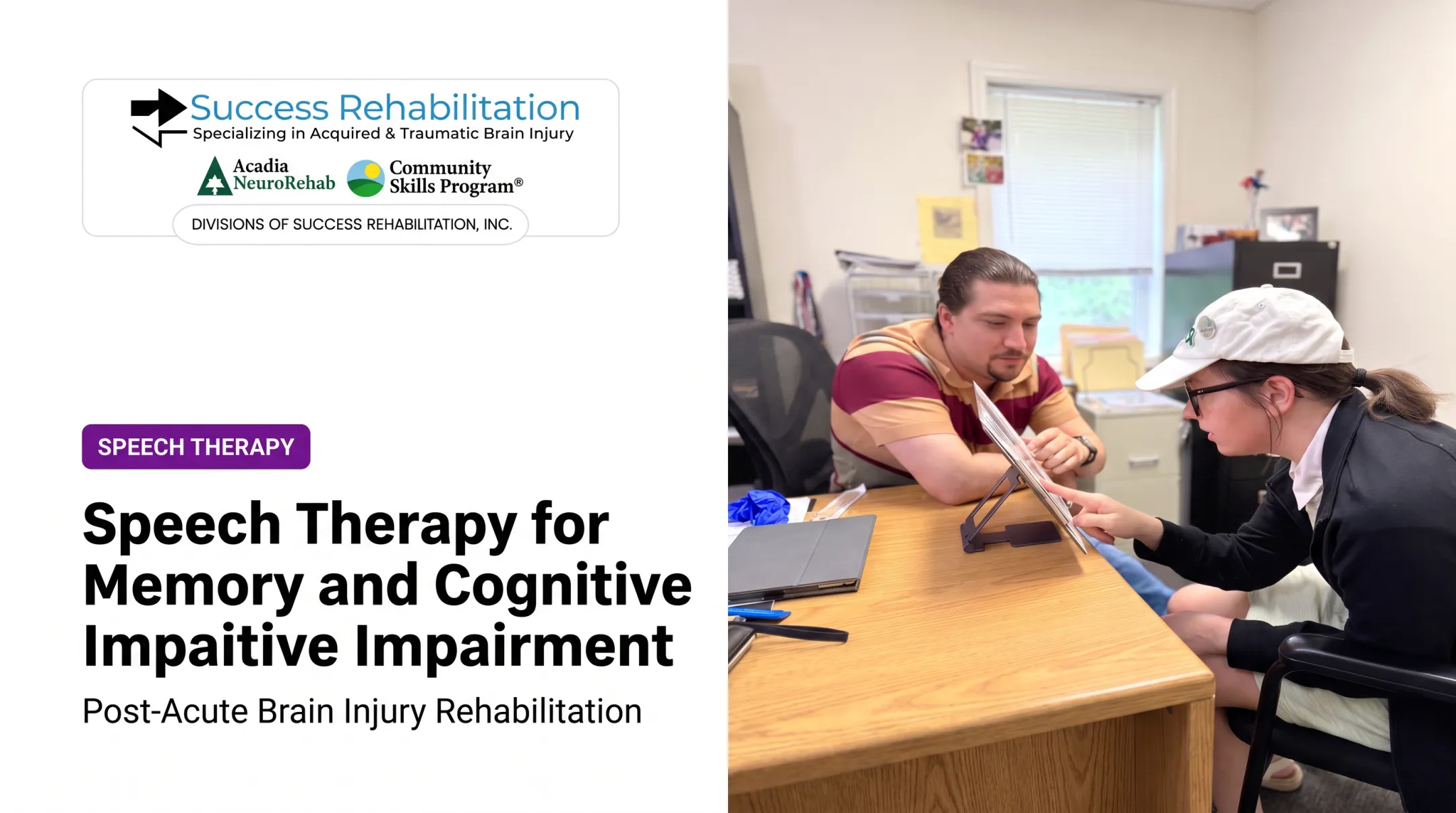
A speech-language pathologist (SLP) starts with a comprehensive evaluation. That assessment covers speech production, language comprehension and expression, cognitive-communication, social communication, and swallowing when indicated. ASHA provides professional guidance on this process.
Therapy approaches for different communication needs
- Aphasia: Tasks target word retrieval, comprehension, reading, writing, sentence formation, and real conversation, chosen for the person's abilities.
- Dysarthria and apraxia: Work may address clarity, breath support, rate, volume, sound production, and motor planning through repeated practice. A qualified clinician should prescribe or adapt exercises.
- Cognitive-communication: Therapy builds attention, memory, planning, organization, problem-solving, and self-monitoring in real-life situations.

Communication tools and assistive strategies
Augmentative and alternative communication (AAC) includes gestures, writing, communication boards, picture supports, typing, and speech-generating devices. These tools support communication. They don't mean someone has given up on speech recovery.
A coordinated continuum of care
Speech therapy often works alongside physical and occupational therapy, behavioral support, nursing, medical care, vocational services, and caregiver education. It can happen in hospital, residential, outpatient, home-based, and community settings.
Success Rehabilitation offers post-acute brain injury rehabilitation across residential, outpatient, neurocognitive, and home- and community-based settings in Pennsylvania and New Jersey. Its speech-language pathology covers speech, language, cognitive-communication, and dysphagia.
Services are individualized, and no specific speech outcome is promised. Speech, physical, and occupational therapy are offered at outpatient locations rather than as in-home services.
Measuring meaningful progress
Clinicians track functional change, such as:
- Clearer communication
- Better word retrieval
- Greater comprehension
- Safer swallowing
- Longer participation in conversation
- Better use of communication tools
- More independence
Validated outcome measures support that tracking. Success Rehabilitation uses the Mayo-Portland Adaptability Inventory (MPAI-4), which covers 29 functional items across ability, adjustment, and participation.

How Families Can Support Speech Recovery
Small changes at home make conversation easier:
- Reduce background noise and distractions
- Speak naturally and respectfully, as to any adult
- Ask one question at a time
- Allow extra time to respond
- Offer choices and confirm meaning
- Don't finish every sentence without permission
Practice only the activities your SLP recommends, and use communication aids consistently. Keep notes on meaningful changes or hard situations to bring to therapy visits.
Caregiver training, patience, and emotional support matter. So does coordination with the rehabilitation team. Respect the survivor's preferences, and protect your own well-being.
A 2025 VA study found caregivers 10-15 years after TBI had, on average, 56.3% of their needs met, with emotional and practical support least often met.
Success Rehabilitation runs a virtual Brain Injury Family & Friends Support Group, and families can join the treatment team when the participant chooses.
Choosing Ongoing Brain Injury Rehabilitation
What to ask a rehabilitation provider
- How much experience do you have with traumatic and acquired brain injury?
- Is speech-language pathology available, and how do you evaluate communication?
- Do you offer swallowing and augmentative and alternative communication (AAC) expertise?
- Is family training included?
- How do disciplines coordinate?
- What settings, transportation, or home-based options exist?
- How are goals measured and shared?
- How do you handle changing needs, plateaus, return-to-work goals, and care-setting transitions?
When continued or specialized support may be useful
Consider a new evaluation or updated plan when:
- Communication needs change
- Progress stalls
- Daily activities remain difficult
- Swallowing concerns arise
- Community participation, work, or independence becomes harder
Also weigh insurance, public benefits, waiver eligibility where applicable, transportation, caregiver capacity, and the level of supervision needed.
Funding varies. Success Rehabilitation, for example, works with Pennsylvania's Head Injury Program, Community HealthChoices, workers' compensation, and private pay.
Frequently Asked Questions
Can you regain speech after a brain injury?
Many people improve, but recovery depends on the injury and the type of communication disorder. Individualized evaluation, therapy, and realistic functional goals shape the outcome.
Is traumatic brain injury (TBI) considered a chronic condition?
For some people, yes. The CDC notes moderate to severe TBI can cause lifelong changes. Outcomes vary widely, and not every survivor has permanent disability.
What speech problems can happen after a brain injury?
Aphasia, dysarthria, apraxia, cognitive-communication problems, social communication difficulties, and swallowing issues are all possible. Get a professional assessment rather than self-diagnosing.
What does a speech-language pathologist do after a brain injury?
An SLP evaluates communication, provides individualized speech, language, and cognitive-communication treatment, and assesses swallowing when needed. They also recommend AAC, monitor progress, and train caregivers.
How long does speech recovery take after a brain injury?
There's no universal timeline. Severity, injury location, health, fatigue, therapy participation, and support all play a part. Improvement may continue over the long term.
How can family help someone recover speech after brain injury?
Be patient in conversation, reduce distractions, and allow extra response time. Use prescribed communication tools, join caregiver training, and work respectfully with the rehabilitation team.