This guide covers the individual workplace needs assessment: a review of how one person's disability, concussion, traumatic brain injury (TBI), acquired brain injury, or other health condition meets the demands of one job. It is different from an organization-wide business needs assessment, which looks at department or company gaps.
You'll learn what the assessment does, what happens during it, what it may include, which challenges come up most, and how to turn findings into a return-to-work plan.
Key Takeaways
- A workplace needs assessment maps the gap between a person's functional abilities and a specific job's demands.
- It weighs strengths, symptoms, environment, duties, current supports, and the employee's goals.
- The output is practical recommendations, not a diagnosis or label.
- Follow-up matters because symptoms, duties, supervisors, and schedules change.
What Is a Workplace Needs Assessment and Why Does It Matter?
An individual workplace needs assessment is a structured review of how a health condition affects work tasks, participation, safety, productivity, and independence.
Pennsylvania's Office of Vocational Rehabilitation describes work-site evaluations that identify modifications, adaptive equipment, and ways to address barriers.
What it is not
- An organization-wide needs assessment that examines business or department gaps
- A medical evaluation focused on diagnosis, treatment, or impairment
- A disability-benefit determination, impairment rating, or workers' compensation entitlement ruling
Why it matters
In a TRACK-TBI cohort of adults with mild TBI, 59% were not working at two weeks and 17% still weren't at 12 months, according to Gaudette and colleagues. Those figures describe one study group, not a universal rate.
A strong assessment gives employees more individualized support and employers clearer communication. It can make work participation safer and offer both sides a realistic path toward reentry or continued employment.
Legal context matters. ADA rules, EEOC guidance, state law, and workers' compensation requirements all shape accommodations, confidentiality, and discrimination protections, and those rules change. The ADA does not mandate one specific assessment process. Confirm current requirements for your situation before acting on any general summary.
What Happens in a Workplace Needs Assessment?
No single template exists, but most assessments follow a similar arc.
Referral and preparation
The assessor gathers background details such as:
- Reason for the referral and the employee's goals
- Job description, essential duties, schedule, and setting
- Past accommodations and relevant clinical or vocational records
Privacy rules apply. EEOC guidance says medical information must be kept confidential, and documentation should establish the need, not exceed it.
The employee interview
The interview is a collaborative conversation. It typically covers:
- Symptoms and daily functioning
- Strengths and work history
- Tasks that are hard, and strategies that already work
- Concerns about disclosure
- The kind of support the employee thinks would help
Other perspectives
With authorization, the assessor may also hear from an employer, supervisor, case manager, treating provider, or family caregiver. Each source adds a distinct view:
- The employee describes lived experience
- The employer explains job requirements
- Care and vocational professionals clarify abilities and restrictions
Worksite review and the final report
When appropriate, and with consent, privacy, and safety addressed, the assessor may review tools, technology, the physical environment, communication demands, workflow, or selected tasks.
The report links each barrier to a specific support, explains the reasoning, and names who should carry it out. It is not a medical diagnosis or a legal determination.

What Does a Disability Assessment Include?
A workplace-focused assessment looks at functional effects, meaning how symptoms show up during real work, rather than stopping at the diagnostic label.
Functional domains
Depending on the person, the review may cover:
- Attention, memory, processing speed, planning, and problem-solving
- Communication and emotional regulation
- Balance, movement, vision, and hearing
- Stamina, pain, and sensory tolerance
Not everyone has every limitation. JAN's brain injury resource cautions that people may have some, but seldom all, of the commonly listed limitations.
Job-demand analysis
The assessor then examines the job itself. Factors typically include:
- Essential duties, pace, multitasking, and deadlines
- Physical requirements and safety-sensitive tasks
- Interpersonal expectations, technology use, and travel
- Attendance demands and how often the person must switch tasks
Occupation-level references such as O*NET help, but the actual job and workplace come first.
Matching abilities to demands
Comparing the two reveals task mismatches, environmental triggers, and strengths worth using. Current supports are documented as well:
- Assistive technology and written instructions
- Scheduling strategies and supervision
- Transportation and family help
- Therapy recommendations, coaching, and routines that already work
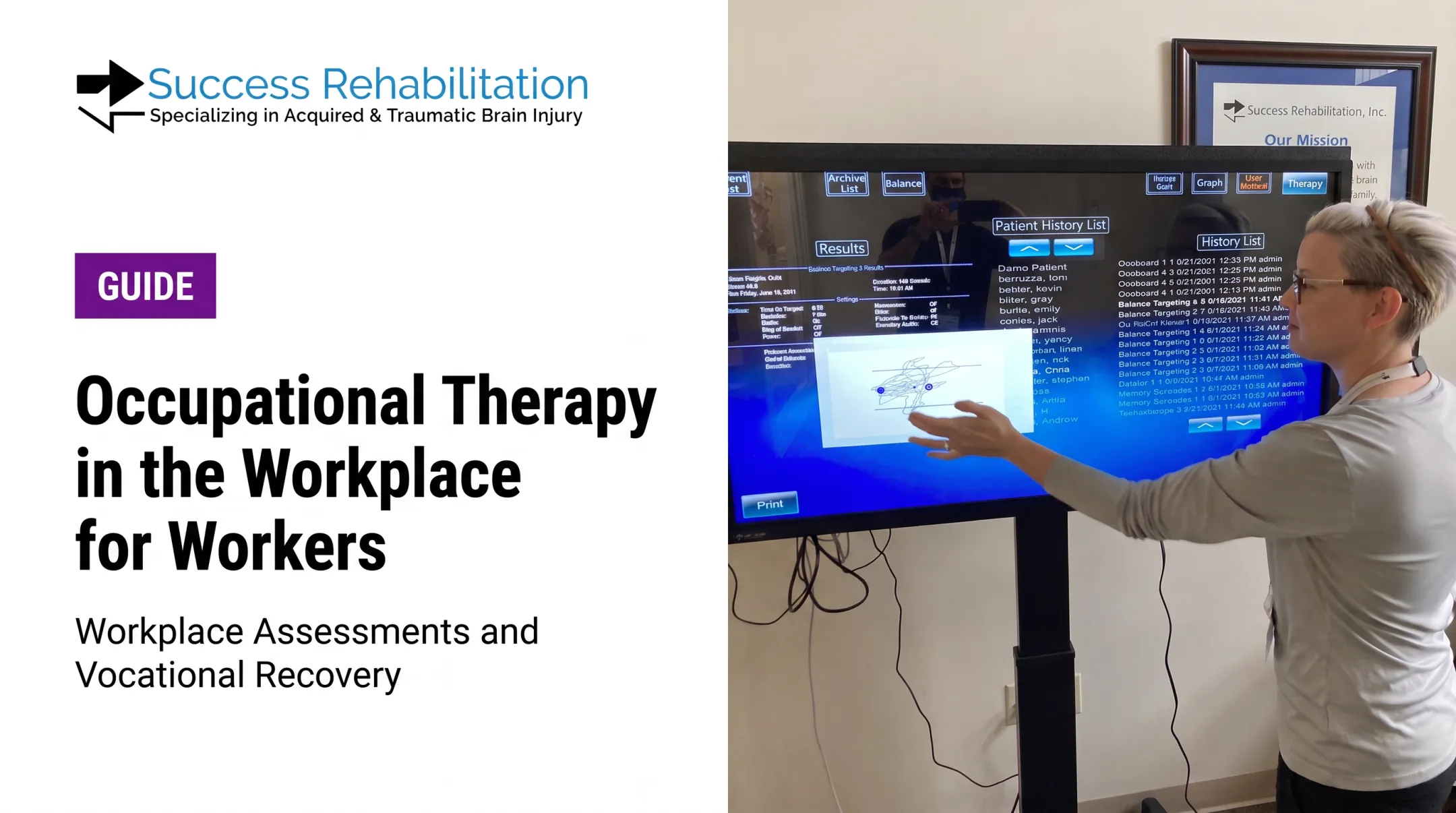
At Success Rehabilitation, occupational therapy includes workplace assessment and return-to-work strategies, with attention to physical function, visual impairments, and work skills. Clients may practice memory aids and a modified work schedule.
Good recommendations stay specific. They often cover changes to:
- Communication, scheduling, or workspace
- Task structure, equipment, or workload
- Supervision or training
Each one should include a plan for checking whether it works.

Common Workplace Challenges and Possible Supports
These are possible assessment topics, not predictions. In the TRACK-TBI symptom study, memory problems and slower thinking persisted in more than 70% of those who reported them at later follow-ups.
Cognitive and executive-function challenges
| Challenge | Possible supports |
|---|---|
| Forgetfulness | Written instructions, reminders, checklists |
| Reduced concentration; overwhelm from interruptions | Quiet workspace, fewer interruptions |
| Slowed processing | Extra time for tasks |
| Trouble starting or prioritizing | Structured routines, task lists |
| Multitasking overload | Reduced multitasking, transition time |
Physical, sensory, and endurance challenges
Headaches, dizziness, balance problems, reduced stamina, light or noise sensitivity, pain, and limited mobility can make a full schedule hard to sustain. The CDC's workplace guidance lists possible responses a provider may recommend:
- Rest breaks, shortened schedules, or later starts
- Sunglasses, earplugs, or headphones
- Reduced screen time, driving, or physical activity
- Temporary transfer to tasks that don't worsen symptoms
- A gradual increase in duties when clinically appropriate
Communication, emotional, and social challenges
Word-finding trouble, difficulty following group discussions, irritability, anxiety, lower stress tolerance, and misreading workplace interactions are common concerns. Supports include:
- Clear written follow-up after meetings
- Predictable feedback
- Private check-ins
- Agreed communication preferences
- Supervisor education
- Access to clinical or vocational support
How to Use Findings in a Return-to-Work Plan
Build a prioritized action plan
Sort findings into tiers:
- Immediate safety needs that block a safe return
- Low-cost adjustments to schedule, tasks, or environment
- Equipment or technology that supports essential duties
- Job redesign and supervision changes
- Training and longer-term rehabilitation goals
Cost is usually modest. In JAN's employer survey, 61% of employers reported no cost for accommodations, and one-time costs had a median of $300, per JAN's cost data.

Hold an implementation meeting
Bring together the employee, employer, rehabilitation professionals, and other authorized parties. Agree on responsibilities, timelines, communication channels, and how confidential information will be handled.
Stage the return
A staged plan can address:
- Hours and workload
- Task complexity and breaks
- Supervision and transportation
- Remote or modified work
- Progress toward essential duties
No schedule fits everyone. CDC guidance ties return-to-work decisions to careful, repeated evaluation of symptoms and cognitive status.
Document and follow up
Write down the agreed supports and set observable questions:
- Can the employee complete essential tasks safely?
- Are fatigue or symptoms increasing?
- Which adjustments need refining?
Reassess when job duties, supervisor, worksite, schedule, symptoms, treatment plan, or level of independence change.
When you need more than a report
Some people recovering from concussion or TBI need ongoing support, not a one-time document. Success Rehabilitation brings a multidisciplinary team:
- Psychologists and physiatrists
- Cognitive rehabilitation, speech, occupational, and physical therapists
- Vocational counseling specialists
Its Community Skills Program delivers cognitive rehabilitation therapy and vocational skills counseling in homes, communities, work settings, and program locations.
Readers in Pennsylvania and New Jersey should confirm program fit, funding, and referral requirements directly. State rules also differ: Pennsylvania's workers' compensation system and Human Relations Act are separate from the New Jersey Law Against Discrimination.
Frequently Asked Questions
What happens in a workplace needs assessment?
The assessor reviews preparation materials, interviews the employee, and analyzes job demands and barriers. They may observe the worksite and gather input from authorized stakeholders, then write recommendations.
Can you give me some examples of workplace challenges?
Common examples include memory problems, fatigue, poor concentration, headaches, dizziness, communication changes, sensory sensitivity, mobility limits, and trouble managing multiple tasks.
What does a disability assessment include?
It may review functional abilities, symptoms, job demands, barriers, existing supports, and recommended accommodations. A workplace assessment is not necessarily a medical diagnosis or disability determination.
Who should participate in a workplace needs assessment?
The employee is the central participant. An employer, supervisor, rehabilitation professional, case manager, or treating provider may contribute when relevant and authorized.
How is a workplace needs assessment different from a medical evaluation?
A medical evaluation focuses on diagnosis, treatment, or impairment. A workplace needs assessment focuses on job demands, functional barriers, accommodations, and work participation.
What happens after a workplace needs assessment?
The parties review recommendations, agree on feasible supports, and document responsibilities. They then implement the plan, monitor outcomes, and reassess if needs or job circumstances change.